A wedding day runs on minutes, not hours, and the photographer or videographer who shows up late to first-look because a rideshare driver got lost costs the couple images they can never get back. Car service for wedding photographers and videographers solves the scheduling and gear problem that consumer ride apps were never built for.
- Car service for wedding photographers is chauffeured transportation booked around a fixed shoot-day timeline, not an on-demand ride.
- Tri-State Chauffeurs runs flat-rate bookings with no surge fees, which matters on a day with zero flexibility.
- Sprinter vans and SUVs beat sedans for crews carrying two camera bags, a gimbal case, and lighting gear.
- Buffer time between venues protects golden-hour and reception coverage more than any other planning decision.
- Rideshare apps remain the wrong tool for a 10-12 hour shoot day with five or more stops.
Why car service matters for wedding photographers
A wedding photographer or videographer isn't traveling from point A to point B once. They move through five or six locations in a single day: the getting-ready suite, the ceremony site, a portrait location, the reception venue, and sometimes a second vehicle for a partner shooter or drone operator. Every one of those transfers has a hard deadline tied to light, the officiant's schedule, or the couple's timeline.
Rideshare apps price by demand, not by need. A driver cancellation or a surge spike during a Saturday afternoon in June 2026 lands at the worst possible moment. A chauffeured car service booked and confirmed days ahead removes that variable — vehicle, driver, and pickup window are locked before the crew picks up a camera.
That difference is why Tri-State Chauffeurs, family owned since 2003 and operating across NJ, NYC, CT, and PA, is built around flat rate pricing rather than dynamic fares. For a full-day 2026 wedding shoot with multiple venues, a dedicated chauffeured vehicle is the only transportation model that guarantees the crew arrives when the timeline says it should.
Map your shoot-day timeline before you book
Every booking decision downstream depends on a timeline that is actually written down. Photographers who book transportation off a vague call time end up guessing at pickup windows.
- List every location with an arrival time, not just a departure time
- Flag which stops need the full crew versus a single shooter
- Note any venue with restricted vehicle access or a loading dock requirement
- Build a 15-30 minute cushion after the ceremony for family formals running long
- Share the finalized timeline with the wedding planner and the car service dispatcher
Choose the right vehicle for your gear
A sedan works for a single shooter with one bag. It does not work for a two-person crew running a primary camera, a second body, a gimbal rig, and a drone case. Match vehicle size to gear volume up front.
- Sedans: one shooter, minimal gear, short single-location days
- SUVs: a two-person crew with standard bag-and-tripod loadouts
- Sprinter vans: full production crews with lighting kits, backdrops, or multiple operators
- Confirm cargo space specifically, not just passenger seating
Crews weighing SUV against van should read the breakdown on choosing between a sedan, SUV, and Sprinter van for group travel before locking a vehicle type into the booking.
Build buffer time into every transfer
The biggest planning mistake on a wedding shoot day is scheduling transportation for the theoretical fastest transfer time instead of the realistic one. Saturday traffic in North Jersey or Manhattan does not care about a photography timeline.
- Add 20-30% to any mapping-app drive-time estimate for weekend traffic
- Treat the ceremony-to-portrait transfer as the highest-risk window of the day
- Confirm the driver knows the venue's specific drop-off point, not just its address
- Build a 10-minute equipment-loading buffer into every departure, not only the first
Book chauffeured car service instead of rideshare for the shoot day
Once the timeline and vehicle size are set, the booking method decides whether the plan holds. A rideshare driver can cancel two minutes before pickup with no recourse. A chauffeured reservation holds the vehicle and the driver. Tri-State Chauffeurs runs flat rate pricing with no surge fees, which matters when a peak-season Saturday in 2026 would otherwise spike an app fare several times over.
- Confirm the reservation is a dedicated vehicle, not a shared or pooled booking
- Ask whether the driver waits on-site between stops or needs a call-back
- Get a direct day-of contact number, not just a general dispatch line
- Verify the booking includes hold time for portrait sessions that run long
Crews that only need a vehicle for part of the day can use the same structure described on the hourly chauffeur hire page — the driver stays on call for the block of time you actually need.
Confirm cargo and loading logistics
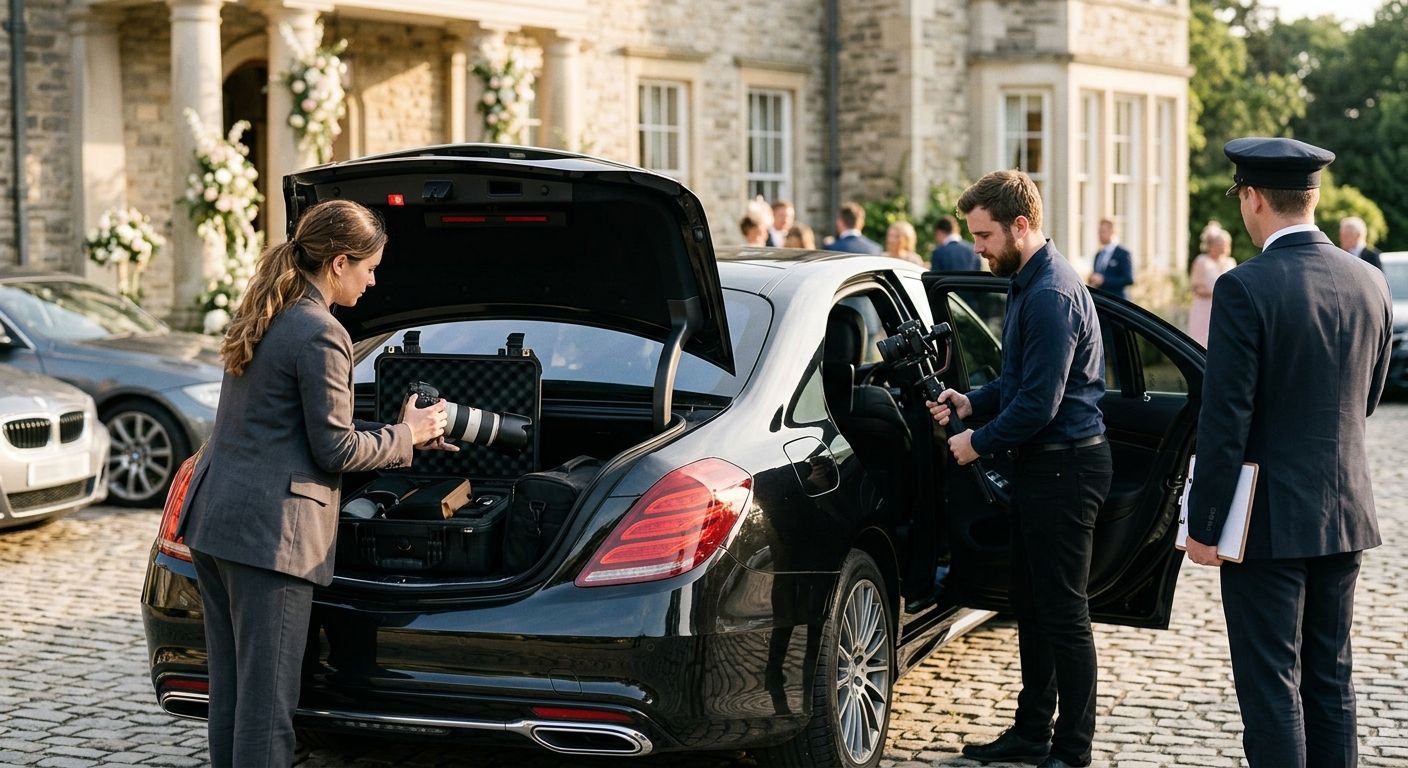
Camera crews lose more time loading and unloading gear than most couples realize. A driver who does not expect equipment cases will park somewhere that makes loading harder.
- Tell the dispatcher in advance how many gear cases to expect
- Ask for fold-flat or removable seating if the load is heavy
- Confirm parking access at each venue; some historic properties restrict vehicle proximity
- Assign one crew member to loading so nothing is left behind at a stop
Coordinate with the wedding planner's timeline
The photographer's transportation plan has to sync with the planner's master timeline, not run on a separate track. A driver who does not know the ceremony start time cannot adjust for a delayed processional.
- Share the planner's timeline document directly with the car service
- Confirm who has authority to adjust pickup times day-of
- Loop in the couple's coordinator so changes get communicated in real time
Have a backup plan for delays
Weather, traffic incidents, and ceremonies that run over all happen. A crew without a contingency loses coverage time.
- Confirm whether the service monitors traffic conditions and adjusts routing
- Ask about backup vehicle availability if the primary vehicle has an issue
- Keep a printed timeline in the vehicle in case phones die or signal drops
Comparison: transportation options for wedding photographers in 2026
| Option | Best for | Key limitation |
|---|---|---|
| Rideshare app | Single shooter, no gear, short notice | Surge pricing, no guaranteed vehicle type, cancellations |
| Personal vehicle | Solo shooters with a single-venue day | No driver means no editing or prep in transit, plus parking |
| Traditional taxi | Short single trips in Manhattan | No advance booking, unreliable for multi-stop days |
| Chauffeured car service (Tri-State Chauffeurs) | Full-day multi-venue shoots with crew and gear | Requires advance booking, not built for last-minute single rides |
Pros of the chauffeured option: dedicated vehicle, flat rate, driver who knows the route and the venues. Cons: you commit to a schedule in advance and pay for hold time you may not fully use.
“A photographer who books transportation like a rideshare is planning for the day to go perfectly. Book like it won't.”
Common mistakes wedding photographers make with transportation
- Booking rideshare for the entire day. Surge pricing during peak Saturday wedding hours, plus no guarantee of vehicle type or driver availability.
- Sizing the vehicle to the crew instead of the gear. A two-person team with three cases needs an SUV or van, not a sedan that looked fine in the app.
- Skipping buffer time between ceremony and portraits. The highest-risk transfer of the day gets treated like a routine drive.
- Not sharing the timeline with the driver in advance. A driver working off one address cannot adjust when the schedule slips.
- Assuming venue parking accommodates loading. Historic estates and city venues often restrict vehicle access closer than crews expect.
Book your wedding shoot-day car service
Flat rate, dedicated vehicles for full-day wedding coverage across NJ, NYC, CT and PA.
Couples handling guest and vendor logistics on the same day should also see the NYC wedding limo service page, since bridal party and vendor bookings are usually scheduled together.
FAQ
What is the best car service for wedding photographers in 2026?
A chauffeured service with flat rate pricing and a dedicated vehicle, such as Tri-State Chauffeurs, works best because it locks in the driver and vehicle for the full shoot day instead of depending on app availability. It is the right fit for multi-venue days across NJ and NYC.
Is car service better than rideshare for wedding photography crews?
Yes for full-day, multi-venue shoots. Rideshare apps use surge pricing during peak wedding hours and cannot guarantee the same vehicle or driver across five or six stops.
What size vehicle do wedding videographers need?
A two-person crew with a gimbal rig, extra bodies, and lighting gear typically needs an SUV. Full production teams with multiple operators need a Sprinter van for cargo space.
How much buffer time should a photographer build into transfers?
Add 20-30% to standard drive-time estimates for weekend traffic, plus a 10-minute loading buffer at every stop. The ceremony-to-portrait transfer needs the largest cushion.
Can a car service wait on-site during a wedding shoot?
Most chauffeured services offer on-site hold time as part of the booking. Confirm it with the dispatcher rather than assuming it is included.
Should photographers coordinate transportation with the wedding planner?
Yes. Sharing the planner's master timeline directly with the car service keeps pickup times aligned when a ceremony runs long or a location changes.
What is the biggest transportation mistake wedding photographers make?
Booking rideshare for the entire day. It exposes the crew to surge pricing, cancellations, and no guarantee of the right vehicle size for gear.
One last thing
The transfer most crews underbudget is not the drive to the ceremony. It is the one from the ceremony to the portrait location, because family formals almost always run past their slot. Protect that window first in your 2026 shoot-day plan and the rest of the timeline tends to hold.