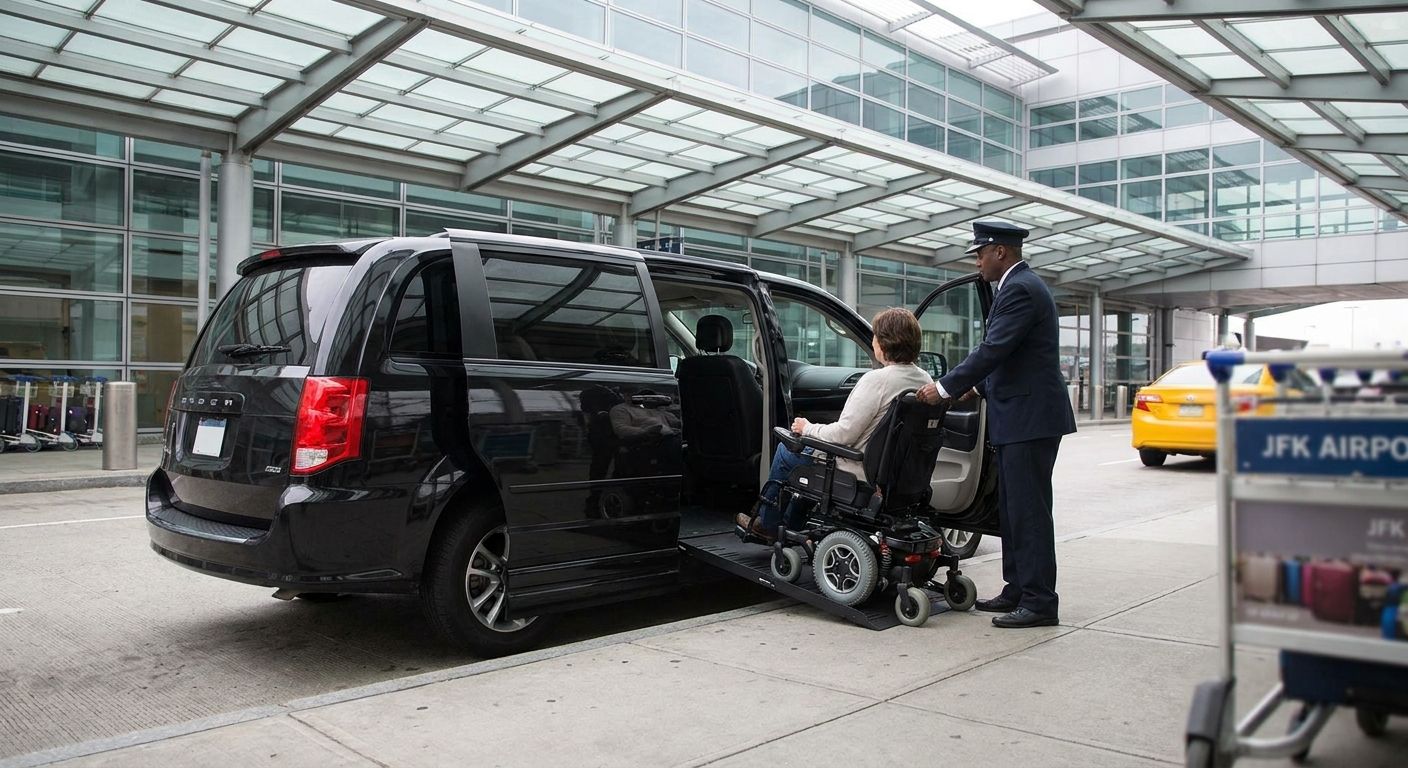
Wheelchair accessible car service in NYC and NJ gets travelers with mobility needs between JFK, LaGuardia, Newark Liberty, and Teterboro without a wheelchair transfer, a folding ramp improvised at curbside, or a paratransit reservation window measured in days. This segment needs a vehicle built for the transfer, not a sedan with a story about "we can probably fit it." Tri-State Chauffeurs runs ramp and lift-equipped vehicles out of Hightstown, NJ and Manhattan, and the difference for a wheelchair user shows up the moment the vehicle pulls up curbside, not after.
- Tri-State Chauffeurs runs ramp and lift-equipped vehicles for wheelchair accessible car service NYC-wide in 2026 — book 48 hours ahead for guaranteed equipment.
- Rideshare WAV coverage stays thin outside Manhattan; paratransit requires advance scheduling and shared rides.
- A dedicated accessible car service beats both on door-to-door timing for flights and medical appointments.
- Confirm ramp width, weight capacity, and tie-down straps before booking, not after the vehicle arrives.
Why wheelchair accessible car service matters for airport travelers
A wheelchair user flying out of JFK or Newark in 2026 is dealing with three moving parts at once: TSA screening timing, terminal distance from drop-off to gate, and a vehicle that can actually load the chair without a struggle. Standard car service sedans and even most SUVs cannot fit a power wheelchair through the door frame or secure it for transit — that's not a service gap, it's a vehicle spec gap.
Paratransit programs like Access-A-Ride solve the cost problem but not the timing problem: reservations typically run on a shared-ride model with pickup windows, which doesn't work for a 6 a.m. international departure. Rideshare wheelchair-accessible vehicle (WAV) options exist through Uber and Lyft, but coverage is inconsistent outside Manhattan and wait times climb fast in Queens, the Bronx, and New Jersey suburbs. A dedicated wheelchair accessible car service NYC travelers can book directly with a set pickup time closes that gap.
Verdict: for flight-dependent trips, a pre-booked accessible car service beats paratransit and rideshare WAV on schedule certainty — the vehicle is confirmed and dispatched, not shared or queued.
Confirm the vehicle type before you book
Not every "accessible" listing means the same equipment. A folding ramp into a minivan and a hydraulic lift into a full-size van are different experiences for a manual chair versus a 300-pound power chair.
- Ask whether the vehicle uses a ramp or a lift
- Confirm interior clearance height for a power wheelchair with headrest
- Check the ramp incline angle if you self-propel
- Verify the vehicle has four-point tie-down straps, not just a floor clamp
- Ask if a second attendant seat is available if you're traveling with a companion
Check ramp and lift capacity against your chair's weight
A power wheelchair with a seat elevator or bariatric frame can run well past 250 pounds fully loaded. Vehicle lifts and ramps carry rated weight limits, and exceeding them is a safety issue, not a formality.
- State your chair's model and approximate loaded weight when booking
- Mention if the chair has a seat-lift or tilt feature that changes height mid-transfer
- Flag scooters separately from power or manual wheelchairs — dimensions differ
- Ask about ramp width if your chair is wider than a standard 26-inch frame
Communicate mobility equipment details in advance
The biggest source of curbside delay isn't traffic — it's a driver arriving without knowing what they're loading. A phone call or booking note with specifics prevents a five-minute scramble at a terminal where every minute matters.
- Chair type: manual, power, scooter, or transport chair
- Folded or fixed frame, and whether it disassembles
- Any oxygen equipment or medical devices traveling with you
- Preferred transfer method: independent, with driver assistance, or with a second person
- Terminal-specific pickup point if you've flown through that airport before
Verify airport meet-and-greet logistics for accessible pickup
Curbside pickup at JFK, LaGuardia, and Newark gets congested, and a wheelchair user waiting at the curb in a crowd isn't a minor inconvenience — it's a real barrier. A driver who meets you inside baggage claim with a sign removes that step entirely.
- Confirm whether meet-and-greet includes baggage claim pickup or curbside only
- Ask for the driver's name and phone number ahead of arrival
- Request a specific meeting point near an accessible exit, not the general curb
- Check if the service tracks your flight for delays automatically
Tri-State Chauffeurs runs a meet and greet service for international arrivals at JFK that puts a driver inside the terminal rather than circling curbside, which matters more for a wheelchair transfer than for an able-bodied traveler with a rolling bag.
Compare accessible car service against paratransit and rideshare WAV
Every option below fits a different trip type. None of them is universally right — the comparison depends on how firm your pickup time needs to be.
| Option | Best for | Key limitation |
|---|---|---|
| Dedicated accessible car service | Flight-dependent airport transfers, medical appointments | Requires advance booking for guaranteed ramp/lift vehicle |
| MTA Access-A-Ride (paratransit) | Local NYC trips on a flexible schedule | Shared-ride model with pickup windows, not fixed times |
| Uber WAV / Lyft Access | Short notice trips inside Manhattan | Coverage and wait times are inconsistent in outer boroughs and NJ |
| Shared airport shuttle van | Budget group travel with no time pressure | Multiple stops add unpredictable time to the trip |
Verdict: dedicated accessible car service wins for anything tied to a flight or appointment time. Paratransit and rideshare WAV work fine when the schedule has slack.
Book in advance for peak travel days
Holiday weeks, graduation season, and major NYC events pull accessible-vehicle demand higher across every provider, not just car service. Booking a day or two ahead protects against a last-minute scramble.
- Book at least 48 hours out for guaranteed ramp or lift vehicle availability
- Book further ahead around holidays, Thanksgiving week, and major NYC events
- Confirm the reservation includes the specific accessible vehicle, not "we'll try to accommodate"
- Ask about return-trip booking at the same time to lock both legs
If you're coordinating a return flight, booking a JFK arrival car service in the same call as your outbound trip avoids a second round of scheduling.
Plan for door-to-door assistance at both ends
A wheelchair accessible car service should handle the transfer at pickup and drop-off, not just the driving in between. That includes securing the chair, managing luggage, and getting you to the correct terminal door.
- Ask if the driver assists with securing the chair inside the vehicle
- Confirm luggage handling is included, not a separate ask
- Request drop-off at the terminal door closest to accessible check-in
- Ask about return pickup coordination if your flight lands late
Book accessible car service now
Confirm ramp or lift equipment and pickup time before you fly.
Common mistakes wheelchair users make booking car service
- Booking a "large SUV" instead of a true accessible vehicle. An Escalade or Suburban does not have a ramp or lift — it's roomier, not accessible.
- Not stating chair weight or dimensions. A driver showing up with a ramp rated below your chair's loaded weight is a safety problem discovered too late.
- Skipping meet-and-greet for international arrivals. Customs and baggage claim at JFK can add 30-45 minutes; a curbside-only pickup means waiting outside that window.
- Booking same-day for a Friday or holiday departure. Accessible-vehicle inventory across every provider in the NYC/NJ market is smaller than standard sedan inventory, and it books out first.
- Assuming all "WAV" listings mean the same equipment. Ramp width, incline, and tie-down setup vary by vehicle even within the same rideshare app.
“A driver who knows your chair's weight before arrival is the difference between a 90-second transfer and a curbside delay.”
FAQ
What is the best wheelchair accessible car service in NYC?
For flight-dependent trips, a dedicated car service with ramp or lift-equipped vehicles beats rideshare WAV and paratransit on schedule certainty. Tri-State Chauffeurs runs accessible vehicles across NYC, NJ, and CT with meet-and-greet pickup at major airports.
Is wheelchair accessible car service better than Access-A-Ride for airport trips?
Yes, for flight timing. Access-A-Ride uses a shared-ride model with pickup windows rather than a fixed time, which creates risk for a flight departure or arrival connection.
Do Uber WAV and Lyft Access cover NYC and NJ airports reliably?
Coverage is strongest in Manhattan and gets inconsistent in the outer boroughs and New Jersey, with wait times that vary by time of day. A pre-booked accessible car service locks a specific vehicle and pickup time instead.
How much advance notice do I need to book an accessible vehicle?
Book at least 48 hours ahead for guaranteed ramp or lift vehicle availability, and further ahead around holidays or major NYC events when accessible-vehicle inventory tightens across every provider.
Can a wheelchair accessible car service handle a power wheelchair over 250 pounds?
It depends on the vehicle's rated ramp and lift weight capacity, so state your chair's approximate loaded weight when booking. Exceeding a rated limit is a safety issue, not a formality.
Does meet-and-greet service work for wheelchair users at JFK?
Yes, and it matters more for a wheelchair transfer than for a traveler with just a rolling bag. A driver meeting you inside baggage claim removes the curbside wait and crowd navigation entirely.
What's the difference between a ramp and a lift vehicle?
A ramp is a folding incline a chair rolls up, best for self-propelled or lighter power chairs; a lift is a hydraulic platform better suited to heavier power chairs or scooters. Ask which equipment type a specific vehicle uses before booking.
Can I book a return airport trip at the same time as the outbound trip?
Yes, and doing so locks both legs to a confirmed accessible vehicle instead of running two separate booking searches. It also lets the service track your return flight for delays automatically.
One last thing
The detail that trips up most bookings isn't the vehicle — it's the terminal door. JFK's Terminal 4 and Newark's Terminal B have accessible entrances that sit a real walk from the general curbside drop zone, and a driver who doesn't know that in advance will drop you at the wrong door. Give the exact terminal and airline when you book, not just the airport code, and confirm the driver knows which entrance to use before the trip, not on arrival.