
Planning corporate shuttle service for a conference comes down to three decisions made in order: lock the attendee count and arrival windows first, match vehicle type to that headcount second, and build the route around session breaks and hotel blocks last. Skip the order and you either strand people curbside during a keynote break or pay a full day of standby time for vehicles nobody uses.
The cost planners overlook most is wait time. A shuttle idling outside a hotel while a keynote runs 20 minutes long bills the same as one that's actually moving, so the schedule matters as much as the fleet size.
- Match fleet size to headcount: sedans and SUVs for under 20 attendees, sprinter vans for 20-50, motorcoaches for 50-plus.
- Book corporate shuttle service for a conference 4-6 weeks ahead for groups over 30 people to lock vehicle availability.
- Build the run schedule around session start times and meal breaks, not fixed hourly intervals.
- A dedicated dispatcher and a corporate account cut the coordination work for multi-day conferences in NYC and NJ in 2026.
- Standby and wait time, not mileage, is the hidden cost most planners underestimate.
Why this matters
A conference shuttle program that runs late reflects on the host company, not the driver. Attendees remember the 25-minute wait outside the Javits Center more than the keynote content, and a badly sized fleet either strands people or burns a budget line on vehicles sitting empty between sessions.
Getting this right in 2026 means treating shuttle planning as a logistics project with a headcount, a schedule, and a fleet spec — not a single phone call two days before the event. Groups moving through venues like the Javits Center or a hotel-block conference in Manhattan need the same discipline: known arrival waves, known departure waves, and vehicles sized to each one.
How to plan corporate shuttle service for a conference
Work through these steps in sequence — each one depends on the answer from the step before it.
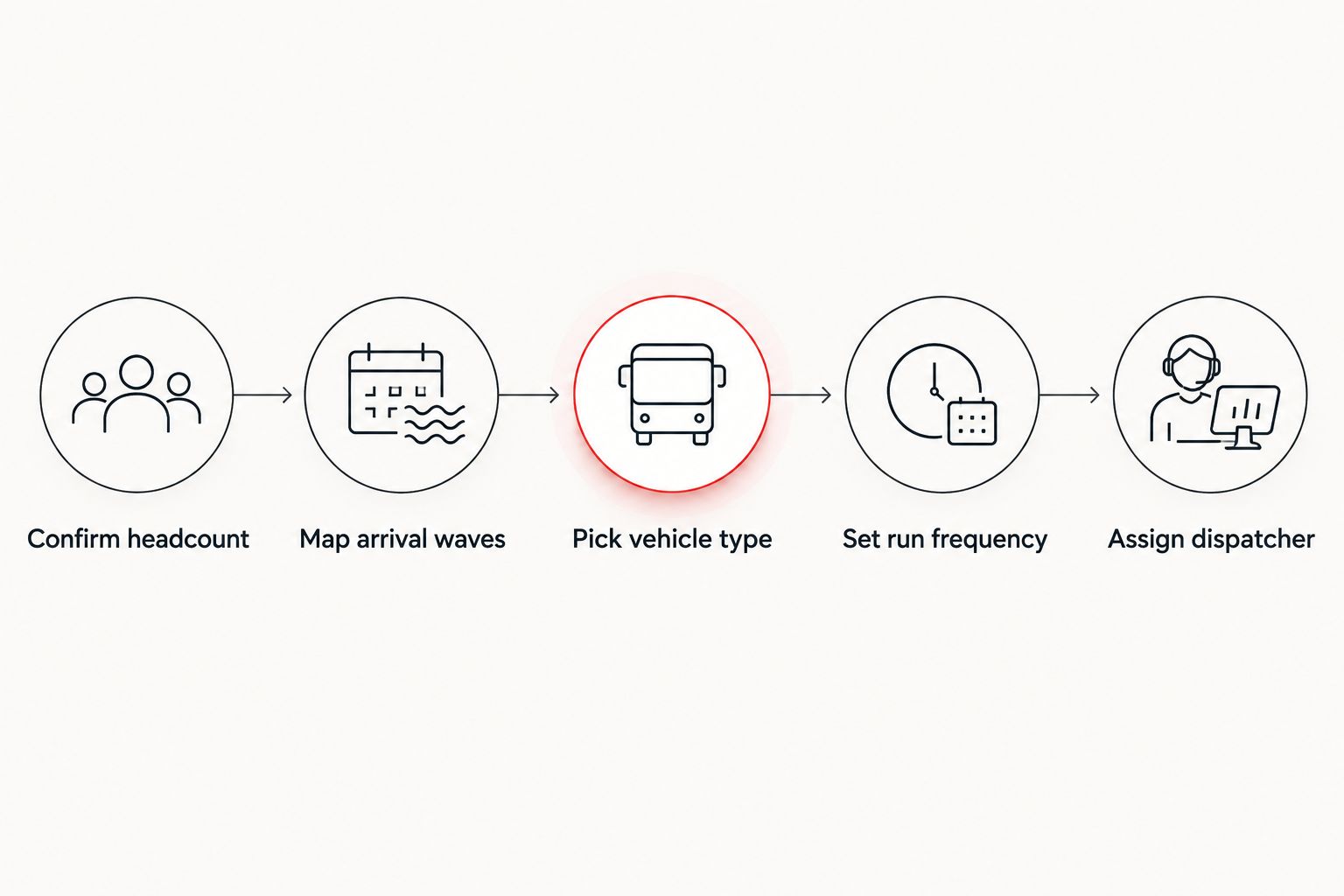
- Get the real headcount, not the registration estimate. Conference RSVPs run high; actual attendance for shuttle purposes should come from confirmed hotel room blocks or badge pickups.
- Map arrival and departure waves. Most conferences cluster arrivals the night before and the morning of, and departures right after the closing session — shuttle demand is not evenly spread across the day.
- Pick vehicle type by group size per run, not total attendee count. A 300-person conference might still move in groups of 12-14 per shuttle load.
- Set a run frequency, not just a headcount — a loop every 20-30 minutes between hotel and venue covers most single-day conferences better than one giant fleet sitting idle.
- Confirm venue loading zones and curb access ahead of time. Convention centers and hotel drop-offs often restrict where a sprinter van or motorcoach can stop.
- Assign a single point of contact — a dispatcher or on-site coordinator — so drivers get real-time updates when a session runs long.
- Book 4-6 weeks out for groups over 30 people. Peak conference season in NYC and NJ books fleets fast, especially around fall and spring event calendars.
Fleet sizing at a glance
| Group size per run | Vehicle type | Typical capacity |
|---|---|---|
| 1-3 executives | Sedan | 3 passengers |
| 4-6 attendees | SUV | 5-6 passengers |
| 8-14 attendees | Sprinter van | 12-14 passengers |
| 20-40 attendees | Minibus | 20-30 passengers |
| 50+ attendees | Motorcoach | 50+ passengers |
These are standard industry capacity ranges, not a promise from any single provider — always confirm the exact seating configuration when booking.
Sedans and SUVs: best for executive arrivals under 6 people
Sedans and SUVs work for VIP speakers, executive teams, or small breakout groups arriving separately from the main attendee block. Best for: speaker pickups and small executive delegations who need flexible timing rather than a fixed loop. The tradeoff is cost per head — running six sedans for 18 people costs more per attendee than one sprinter van, and it multiplies the number of pickup points a dispatcher has to track.
Sprinter vans: best for groups of 20-50 people between hotel and venue
A sprinter van seats roughly 12-14 passengers and is the workhorse for conference shuttle loops in 2026 — enough capacity to move a meaningful group without the size restrictions a full motorcoach runs into at tighter hotel entrances. Best for: repeated hotel-to-venue loops on a fixed schedule. The sprinter van rental option fits multi-day conferences where the same route runs every morning and evening. The downside: at 40+ attendees per wave, you need multiple vans running in sequence, which means more drivers to coordinate.
Motorcoaches: best for single-venue conferences with 50+ attendees
Motorcoaches carry the full group in one or two loads, which simplifies dispatching for large single-site conferences. Best for: one departure point, one arrival point, minimal stops. They're a poor fit for conferences spread across multiple hotels, since a coach can't efficiently zigzag between pickup points the way a fleet of smaller vans can.
Still unsure which vehicle class fits your group? The guide on choosing between a sedan, SUV, and sprinter van for group travel breaks down the tradeoffs by group size and luggage volume.
Why shuttle costs and fleet size vary
- Number of pickup/drop-off points — one hotel versus a multi-hotel block changes route complexity and vehicle count needed.
- Session schedule tightness — back-to-back sessions with 15-minute breaks demand more frequent loops than a conference with long lunch breaks.
- Venue access restrictions — some convention centers limit coach parking and loading dock time, forcing smaller vehicles into more frequent runs.
- Standby and wait time — a shuttle held on-site during a delayed session bills differently than one running a continuous loop.
- Multi-day versus single-day events — multi-day conferences often justify a corporate account with a fixed rate structure instead of booking each day separately.
- Peak season demand — spring and fall conference calendars in NYC and NJ compress vehicle availability, which is why 4-6 week lead time matters more in those windows.
“Vehicle selection only works after headcount and arrival waves are locked — pick the fleet first and the schedule never fits.”
For conferences that repeat annually or run alongside other business travel, a corporate car service account for businesses with frequent travel removes the re-booking work each cycle and keeps a dedicated point of contact on file.
Plan your conference shuttle fleet
Get a fleet recommendation based on your headcount and schedule.
How many shuttles do I need for a 200-person conference?
A 200-person conference typically needs 4-6 sprinter vans running continuous loops, or 2-3 motorcoaches if arrivals and departures cluster into two or three waves. The right number depends on how tightly the session schedule is packed and how many hotel pickup points are in play.
How far in advance should I book conference shuttle service?
Book 4-6 weeks ahead for groups over 30 people, and earlier during peak spring and fall conference season in NYC and NJ. Smaller executive pickups of 6 people or fewer can often be arranged with a shorter lead time.
Do shuttle drivers wait during delayed sessions?
Yes, drivers typically hold at the venue when a session runs long, and that standby time is part of what drives up total cost on a shuttle contract. Building buffer time into the run schedule up front reduces how often this happens.
FAQ
What's the best vehicle for a small conference shuttle group?
A sprinter van, seating roughly 12-14 passengers, is the best fit for groups of 20-50 moving between one hotel and one venue. Smaller executive groups under 6 people are better served by an SUV.
How much does corporate shuttle service for a conference cost?
Cost depends on vehicle type, run frequency, and standby time rather than a flat per-day rate. Multi-day or recurring conferences often get better terms through a corporate account than day-by-day booking.
Is a sprinter van or motorcoach better for a conference shuttle?
Sprinter vans work better for multi-hotel pickups because they can run frequent, flexible loops; motorcoaches work better for single-venue conferences with one pickup and one drop-off point.
How do I schedule shuttle runs around conference sessions?
Set run frequency around the actual session start times and break lengths, not a fixed hourly schedule. A 20-30 minute loop covers most single-day conferences with staggered breaks.
Do I need a dispatcher for conference shuttle service?
Yes, a single point of contact who can update drivers when a session runs long keeps the shuttle loop on schedule. Without one, delays compound across every subsequent run.
When should I book shuttle service for a large conference?
Book 4-6 weeks out for groups over 30 people, especially during spring and fall conference season in 2026 when fleet availability in NYC and NJ tightens.
Can shuttle service handle multiple hotel pickup points?
Yes, but each additional hotel adds route complexity and usually requires more vehicles running staggered loops instead of one large coach.
One last thing
The planners who avoid shuttle chaos aren't the ones with the biggest fleet — they're the ones who build a 10-15 minute buffer into every run before the first session even starts. That single habit absorbs the late keynote and the slow badge line without cascading delays through the rest of the day.