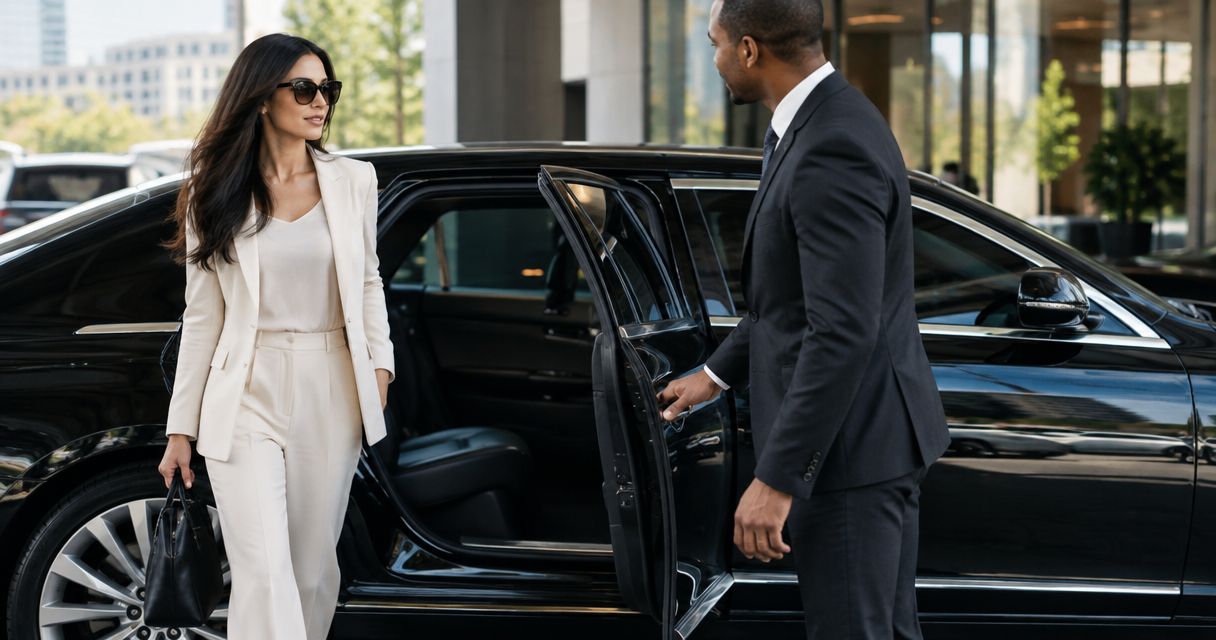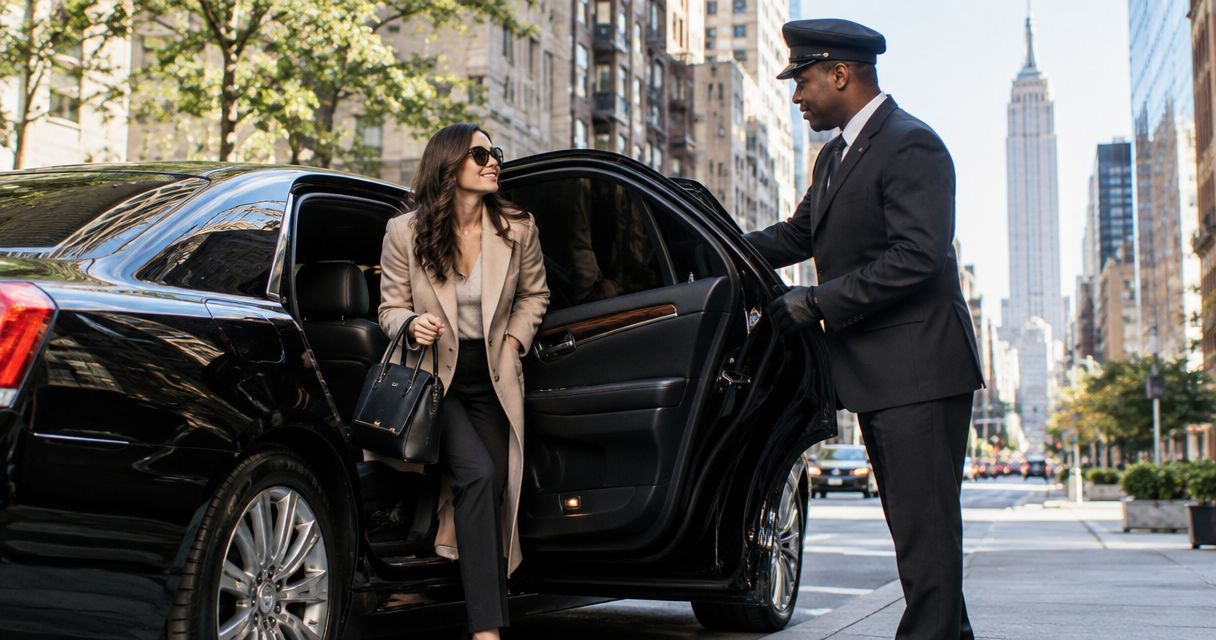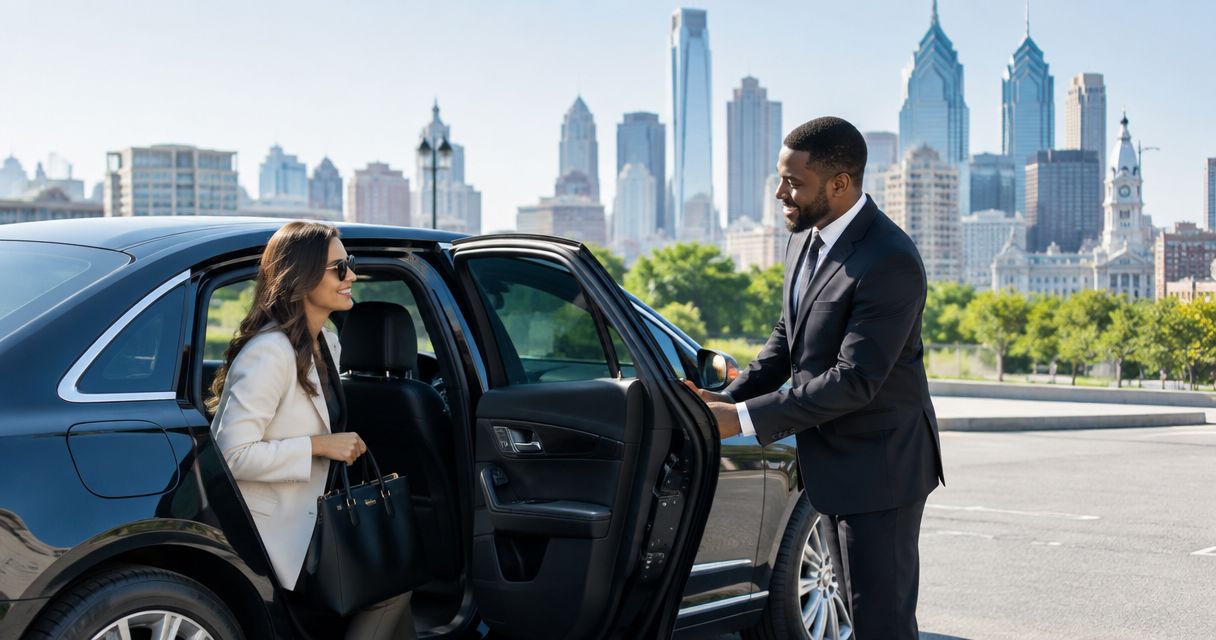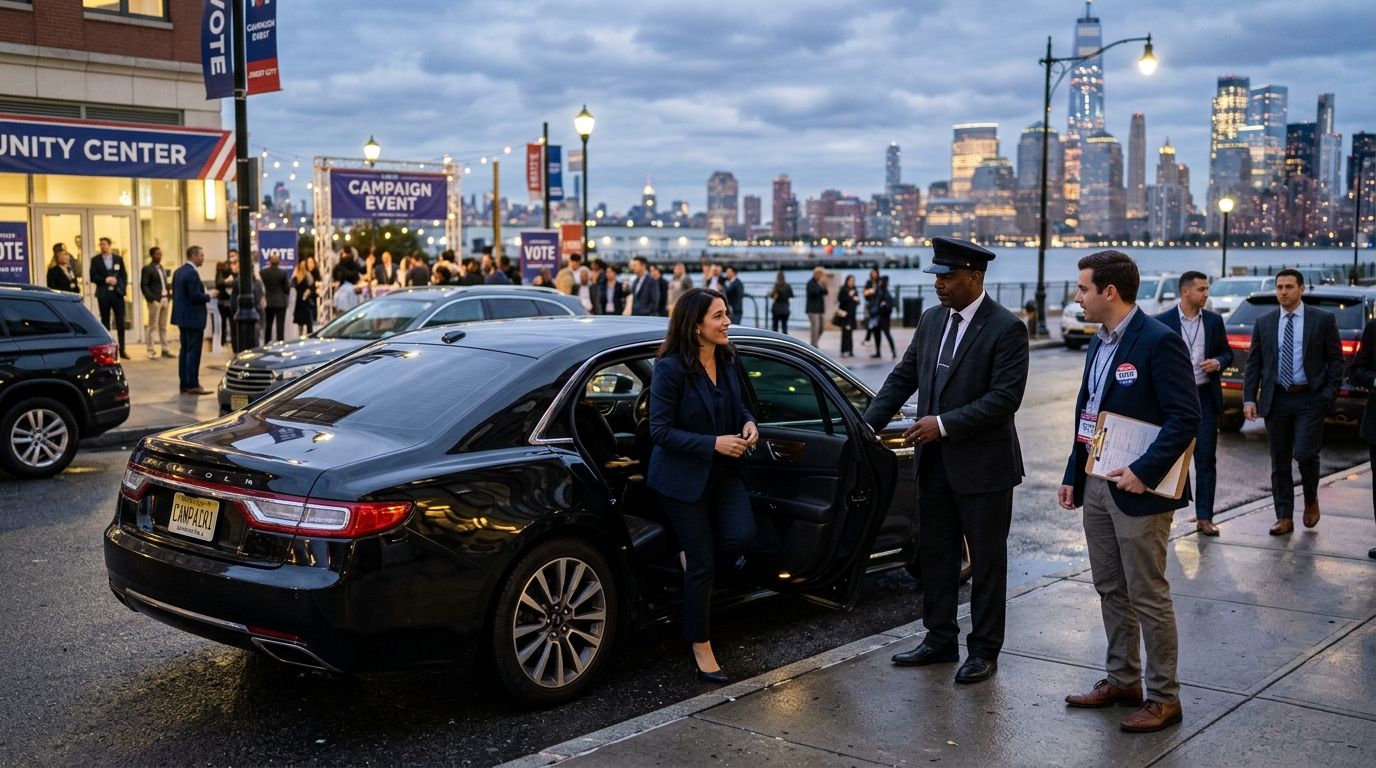
Car service for political campaign events in NJ and NYC moves candidates, staff, surrogates, and field teams between rallies, fundraisers, debate walk-throughs, and press hits on a schedule that changes by the hour, not on the fixed pickup window a rideshare app assumes. Campaign logistics run differently from a corporate meeting or a wedding party: the departure time on the call sheet at 8 a.m. is rarely the departure time by 3 p.m., and a missed window can mean a missed live shot.
- Car service for political campaign events works best with a standing account and 2+ vehicles booked in parallel.
- Tri-State Chauffeurs runs sedans, SUVs, and Sprinter vans across NJ, NYC, CT, and PA for 2026 campaign travel.
- Same-day schedule slips are normal on the trail; flight tracking and live dispatch beat rideshare surge pricing.
- Best for campaigns needing discreet, background-screened drivers who show up without branding or a fixed clock.
Why car service matters for campaign logistics
A campaign day is built around windows, not appointments. A candidate might do a 7 a.m. diner stop in Mercer County, a noon fundraiser in Manhattan, and an evening debate prep session back in New Jersey — and every one of those windows moves if a prior event runs long.
Rideshare apps price by demand. That means the exact days a campaign needs the most cars — a rally, a debate night, a big-name endorsement event — are the days surge pricing spikes hardest and drivers get scarcest. A chauffeur service on flat rate pricing with no surge fees removes that variable.
Tri-State Chauffeurs has completed 240,000+ rides since 2003 and holds a 5-star Google rating, built largely on time-sensitive bookings across NJ, NYC, CT, and PA. That is the shape of a campaign day.
Verdict: campaigns that plan multi-vehicle logistics and lock a standing account rarely lose time to transportation in 2026; campaigns that book one car per event, day-of, do.
How to line up car service for a campaign event
Map the full day before you call anyone
A single booking for a single event is the wrong unit. Campaign days are chains — venue to venue, with press and staff moving on a slightly different clock than the candidate.
- List every stop with an earliest and latest acceptable arrival time
- Flag which stops are hard-fixed (a live TV hit, a debate) versus flexible (a meet-and-greet)
- Note who travels with the candidate versus who moves separately (advance team, press pool)
- Identify overlap risk: two events 40 minutes apart with a 25-minute drive between them
Book more than one vehicle for parallel movement
One car covering a candidate, staff, and press gear becomes a bottleneck the moment the schedule slips. Campaigns that run smoothly split the movement.
- A sedan or SUV dedicated to the candidate and immediate staff
- A second vehicle for advance team members who need to arrive early and scout
- A van for press pool equipment and larger field teams
- One floater car on standby for schedule collisions, not just breakdowns
Match the vehicle to the group, not the guest list on paper
A sedan works for a candidate and one aide moving between two nearby stops. A full field team, a press pool, or a GOTV canvassing crew needs something built for group size plus gear. The breakdown on choosing between a sedan, SUV, and Sprinter van covers where each option fails at the margins — read it before the schedule is final, not after a Sprinter shows up for a two-person hop.
Vet the driver for discretion, not just a license
A campaign car is a moving extension of the operation. A driver who asks questions, wears campaign gear, or talks about the ride is a liability regardless of how clean the drive was.
- Confirm the driver is briefed on discretion expectations before pickup, not during it
- Ask whether the same chauffeur can stay assigned across a multi-stop day
- Confirm the vehicle carries no branding or identifiers tied to any campaign or party
- Ask about background screening on assigned drivers
Build slack into every pickup time
Events run over. Flights carrying a surrogate or a national-level guest get delayed. The transportation plan has to absorb that without cascading through the whole day.
- Add a 15-20 minute buffer to every scheduled pickup, not just the first one
- For anyone flying in for a rally or fundraiser, use car service with flight tracking for delayed arrivals so the pickup adjusts without a phone call
- Keep one vehicle unassigned mid-day as a floater for whichever leg runs longest
- Confirm the dispatcher, not only the driver, holds the day's full schedule
Put the campaign on a standing account
Booking each stop as a one-off means renegotiating logistics every time staff or the schedule changes. A standing account with one dispatch contact ends that.
- Set up recurring billing that matches campaign finance reporting requirements
- Assign one point of contact on the campaign side for all schedule changes
- Pre-authorize the staff who can request rides without re-verifying each time
- Confirm the provider can add or drop vehicles same-day
Plan the exit before the event starts
The logistics failure that actually costs campaigns time is rarely the ride in. It is getting the candidate out through a crowd, a press scrum, or a lot gridlocked by attendee cars.
- Stage the pickup vehicle at a pre-agreed exit point, not the main entrance
- Brief the driver on the exit route and any road closures tied to the event
- Set the exit time with the advance team, not just with the driver
- Name a backup exit point in case the primary one gets blocked by crowd overflow
Comparison: transportation options for campaign events
| Option | Best for | Key limitation |
|---|---|---|
| Staff-driven personal vehicle | Small, informal local stops | No redundancy when the driver is also working the event |
| Rideshare apps | One-off, low-stakes trips | Surge pricing on high-demand event days, no discretion vetting |
| Car service booked per event | Single events planned far ahead | Renegotiating logistics every booking, no dispatch continuity |
| Chauffeur service on a standing account (Tri-State Chauffeurs) | Multi-stop campaign days with staff and press moving in parallel | Requires account setup before the first event |
Verdict: a standing account with a chauffeur service wins for any 2026 campaign running more than a handful of events — it is the only option built to absorb same-day changes without starting over each time.
Set up a campaign travel account
One dispatch contact, recurring billing, same-day vehicle changes.
Common mistakes campaigns make with transportation
- Booking one car per event instead of one plan per day. A single vehicle covering the candidate and the press pool bottlenecks the second the schedule shifts.
- Ignoring the exit. Getting the candidate out of a packed venue matters as much as the ride in, and it is the step most schedules skip.
- Booking day-of during peak windows. Rally days, debate nights, and convention weeks are exactly when rideshare surge pricing and availability get worst.
- Skipping discretion vetting. A driver who was never briefed on confidentiality is a risk no matter how punctual the pickup was.
- Forgetting CT and PA reach. Campaigns working the full Tri-State region need a provider that actually runs into Connecticut and Pennsylvania, not just NJ and NYC.
“Plan the exit first, then build the rest of the campaign day's transportation around it.”
Where hourly hire beats point-to-point
Campaign days with unpredictable end times are a poor fit for point-to-point bookings, because every leg has to be priced and confirmed as the day changes. Hourly hire holds the car and the driver for a block of time instead. The guide to hourly chauffeur hire for NYC business meetings applies directly to campaign travel: same structure, same reason — the schedule is not knowable in advance.
Use hourly hire on debate days, fundraiser evenings, and any day with three or more stops in Manhattan. Use point-to-point for a single airport run or one fixed event with a known end time.
FAQ
What's the best car service for political campaign events in NJ and NYC?
A chauffeur service on a standing account with multi-vehicle capacity across NJ, NYC, CT, and PA is the best fit for 2026 campaign schedules. It absorbs same-day changes without renegotiating each booking.
Can a campaign set up a standing account for recurring bookings?
Yes. A standing account assigns one dispatch contact and lets pre-authorized staff request rides without re-verifying details each time, which matters when the schedule changes hourly.
How fast can a car be booked for a same-day rally?
Same-day booking is realistic once an account exists, because billing and the approved-staff list are already on file. Cold bookings without an account take longer to confirm.
Do chauffeurs keep campaign travel confidential?
Confirm discretion expectations with the provider before the first booking, including unbranded vehicles and drivers briefed not to discuss the day. Ask about background screening at the same time.
What vehicle works best for moving a full field team?
A Sprinter van or large SUV fits a field team with gear far better than a sedan. A sedan is built for one or two riders plus light luggage.
Is car service more reliable than rideshare for campaign events?
Yes on high-demand days. Rideshare pricing surges during rallies, debates, and conventions, exactly when a campaign needs the most cars, while flat rate car service pricing does not move with demand.
Can one booking cover multiple pickups across NJ, NYC, CT, and PA?
A regional chauffeur service built for the Tri-State area can run multi-stop days across all four states in a single booking. A single-city car service typically cannot.
What happens if a surrogate's flight is delayed before an event?
A service with live flight tracking moves the pickup automatically instead of waiting on a rebooking call. That keeps the rest of the day's schedule intact.
One last thing
The cheapest fix on a campaign day costs nothing: name the exit point and the backup exit point in writing when you book, not on the radio ten minutes before the candidate walks off stage. Crowd overflow blocks main entrances constantly at 2026 rallies, and a driver staged at the wrong door burns more minutes than any traffic route ever will.